The Machine That Built the Vertical Metropolis
Before the middle of the nineteenth century, the architectural horizon of human civilization was strictly constrained by a biological reality: the endurance of human leg muscles. Throughout ancient Rome, medieval Paris, and nineteenth-century London, residential and commercial buildings rarely exceeded five or six stories in height. Renting the top floor of a building was a mark of poverty; climbing five flights of winding stairs multiple times per day was an exhausting physical ordeal. Human cities were forced to spread laterally across geographical space, consuming land and creating sprawling congestion.
Today, our planetary civilization is defined by towering vertical megacities: crystalline skyscrapers soaring eighty, one hundred, or one hundred and sixty stories into the clouds—exemplified by the Burj Khalifa in Dubai, the Shanghai Tower, and One World Trade Center in New York. What made this vertical architectural revolution possible was not the discovery of steel beams or reinforced concrete; it was the invention and perfection of The Modern Passenger Elevator.
Every single day, elevators transport over one billion human passengers vertically—traveling billions of passenger-kilometers, making the elevator statistically and empirically the safest mode of mechanical transportation on Earth. Yet inside that smooth, quiet vertical cabin, passengers rarely contemplate the monumental physics and redundant safety engineering holding them aloft: traction sheave friction drives, gravitational counterweight balance, hydro-pneumatic buffers, governor overspeed safety brakes, and destination dispatch algorithms. In this comprehensive mechanical engineering masterclass, we dissect the inner mechanisms that lift the modern world.
🏗️ The Historic Elisha Otis Breakthrough (1854)
‘In 1854, at the New York Crystal Palace Exposition, inventor Elisha Graves Otis stood upon an open hoisting platform elevated high above an astonished crowd. With an axe, his assistant severed the only rope supporting the platform. The crowd shrieked in terror. Instead of plummeting to the floor, Otis’s spring-loaded safety brake engaged instantaneously, arresting the fall in fractions of a second. Otis tipped his hat and proclaimed: All safe, gentlemen, all safe. The vertical city was born.’
Traction Drives vs. Hydraulic Elevators: The Physics of Lifting
Modern commercial elevator engineering is divided into two primary mechanical architectural classes, each optimized for specific vertical transit envelopes:
- Hydraulic Elevators: The elevator car is mounted upon a heavy steel piston (plunger) that slides inside a pressurized cylinder sunk deep into the ground or mounted alongside the hoistway. An electric pump forces pressurized hydraulic oil into the cylinder, extending the piston upward to raise the car. Hydraulic elevators are robust, simple, and require zero heavy overhead machine rooms; however, they are severely speed-limited (typically 0.5 to 1.0 m/s) and restricted to low-rise buildings (under six stories) because drilling a 50-meter underground cylinder hole becomes economically unviable.
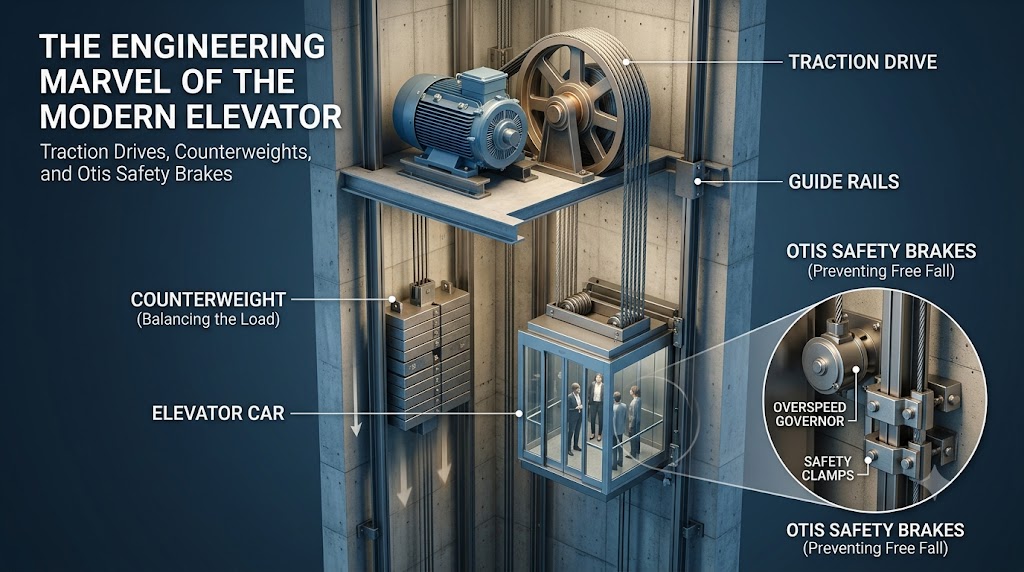
- Traction Drive Elevators: The undisputed king of mid-rise and high-rise vertical transport. The elevator car is suspended by high-strength steel wire ropes (or polyurethane-coated steel belts) that loop over a grooved drive pulley—known as the Traction Sheave—connected to an electric motor located in an overhead machine room or mounted directly within the hoistway (Machine-Room-Less / MRL systems). Traction elevators achieve breathtaking vertical speeds exceeding 10 to 20 meters per second (up to 45 mph / 72 km/h) in modern supertall skyscrapers.
| Elevator System | Drive Mechanism | Vertical Travel Range | Maximum Speed Range | Primary Energy Efficiency Feature |
|---|---|---|---|---|
| Hydraulic Plunger | Pressurized hydraulic oil pumping into steel piston | Low-rise (2 – 6 floors / < 20m) | 0.3 – 1.0 m/s (Slow) | Gravity descent consumes zero motor power; pump energy high on ascent |
| Geared Traction | High-speed AC/DC motor with worm gear reduction | Mid-rise (5 – 25 floors / < 90m) | 1.0 – 2.5 m/s (Moderate) | Counterweight balancing 40-50% car load; worm drive mechanical braking |
| Gearless Traction (PMSM) | Direct-drive Permanent Magnet Synchronous Motor | Supertall (20 – 160+ floors / up to 600m) | 2.5 – 20.5 m/s (Blistering) | Regenerative drives feeding electricity back to grid during braking |
| Machine-Room-Less (MRL) | Ultra-compact gearless motor inside hoistway head | Low to Mid-rise (4 – 30 floors / < 100m) | 1.0 – 3.0 m/s | Eliminates rooftop penthouse machine room; 50% energy savings |
| Twin / Double-Deck | Two independent cars sharing single hoistway | Super-high density skyscrapers | 4.0 – 10.0 m/s | Doubles passenger throughput capacity without adding hoistway shafts |
The Counterweight Principle: The Gravitational Balance Machine
The most common public misconception regarding traction elevators is that the electric motor hoists the entire gross weight of the elevator car and its passengers from a dead deadlift. If an electric motor had to lift a 2,000-kilogram elevator car filled with twenty passengers from ground to penthouse, it would require a monstrous, energy-guzzling industrial motor, and descending would generate immense kinetic energy that would incinerate mechanical brakes.
Traction elevators operate on the physics of Gravitational Counterbalancing:
Suspended from the opposite end of the hoist ropes is a heavy rectangular steel frame filled with dense cast-iron or concrete weights—the Counterweight. The mass of the counterweight is precisely calculated by mechanical engineers:
$$ ext{Mass}_{ ext{Counterweight}} = ext{Tare Mass of Car} + (0.40 ext{ to } 0.50) imes ext{Rated Passenger Capacity}$$
The counterweight perfectly balances the empty car plus 40% to 50% of its maximum rated passenger payload (the average statistical occupancy of an elevator in daily service). Consequently, the electric motor never lifts the full weight of the car; the motor only needs to provide the minute torque required to overcome mechanical friction, cable inertia, and the imbalance difference between the car and the counterweight. When an elevator descends with a full passenger load, or ascends empty, the system acts as a mechanical see-saw: gravity does virtually all the heavy lifting!
⚡ Regenerative Braking in Supertalls
‘In modern gearless traction elevators, the motor acts as an electrical generator when the heavy counterweight descends (lifting an empty car) or when a full car descends (lifting the lighter counterweight). Through regenerative Variable Voltage Variable Frequency (VVVF) inverters, the motor converts gravitational kinetic energy into clean electricity, feeding up to 30% of consumed power back into the building’s electrical grid!’
Traction Sheave Physics: Euler’s Capstan Equation and Cable Grooves
The steel wire ropes are not clamped or fastened to the drive sheave; they simply rest inside machined grooves across the sheave’s curved circumference. What prevents the cables from slipping when the motor spins?
The physics of cable traction is modeled by Euler’s Capstan Equation (The Belt Friction Formula):
T1 / T2 <= e^(mu * theta)
Where $T_1$ and $T_2$ are the cable tensions on the car and counterweight sides, mu is the apparent coefficient of friction, and theta is the angle of cable wrap around the sheave (typically 180 degrees for single-wrap, or up to 360 degrees for double-wrap traction drives).
To maximize friction without shredding the steel cables, mechanical engineers machine specialized groove profiles into the ductile cast-iron or hardened steel sheave rim:
- U-Grooves: Semicircular grooves matching cable curvature. Provides gentle cable wear but modest traction, requiring double-wrap pulleys in high-speed applications.
- V-Grooves: Sharply angled wedge grooves (35 to 40 degrees). The cable is wedged deeply into the V, vastly increasing the apparent friction coefficient
mu, though accelerating cable fatigue. - Undercut U-Grooves: The modern commercial gold standard. A semicircular groove with a machined hollow undercut at the bottom, delivering high wedging friction while distributing contact pressure across the cable strands.
Elevator hoist cables are composed of six to eight independent steel wire ropes, each containing dozens of cold-drawn high-tensile steel strands wrapped around a natural sisal or synthetic polymer core. Each single cable is engineered with a safety factor exceeding 10 to 12: a single cable can effortlessly hold the entire fully loaded car alone. Snapping all six to eight cables simultaneously is a statistical impossibility in certified vertical transport.
The Safety Gauntlet: Governor Brakes and Hydraulic Buffers
Even if an impossible catastrophic failure severed every single hoist cable simultaneously, an elevator car would still not plummet to the bottom of the shaft. Modern elevators are protected by an impenetrable, multi-tiered mechanical safety chain codified under ASME A17.1 / EN 81 safety standards:
- The Mechanical Overspeed Governor: Mounted in the machine room or overhead hoistway is an independent centrifugal governor driven by a dedicated steel aircraft cable attached to the car. As the car moves, the governor wheel spins. If the car accelerates beyond 115% of its rated speed (due to motor failure or broken cables), centrifugal flyweights swing outward against calibrated springs, mechanically tripping an electrical kill switch that cuts power to the motor and drops the main machine brake.
- The Progressive Safety Clamps (The Otis Brake): If the car continues to accelerate past 125% of rated speed, the governor cable clamps mechanically, pulling up on an emergency linkage mounted to the car’s structural safety plank beneath the floor. This linkage drives heavy, serrated hardened tool-steel wedges or eccentric rollers into the structural vertical steel Guide Rails anchored to the building columns. The wedges dig into the steel rails with immense frictional clamping force, sliding to a controlled, progressive stop over one to two meters, decelerating passengers safely without neck-breaking impact.
- Hoistway Terminal Buffers: At the very bottom pit of the elevator shaft sit giant heavy-duty Oil Hydraulic Buffers. If an elevator over-travels past the lowest floor at terminal velocity, the car strikes the hydraulic buffer plungers, which force hydraulic oil through metered orifices, dissipating the entire kinetic energy of the car at a safe, survivable deceleration rate ($< 1.0G$).
High-Rise Hoistway Aerodynamics and Building Sway Kinematics
When an ultra-high-speed elevator in a supertall skyscraper—such as the Taipei 101 or Guangzhou CTF Finance Centre—travels at velocities exceeding 20 meters per second (45 mph) inside an enclosed vertical concrete shaft, it encounters severe aerodynamic challenges analogous to a high-speed bullet train entering a narrow mountain tunnel:
- The Piston Effect: The rapidly moving elevator car pushes a massive column of air ahead of it, creating a high-pressure shock wave beneath the car and a deep low-pressure vacuum wake behind it. If left unmanaged, this aerodynamic pressure differential creates terrifying acoustic roaring, ear-popping pressure changes for passengers, and severe lateral vibration.
- Aerodynamic Streamlining: Supertall elevator cabs are fitted with custom aerodynamic nose and tail fairings—sculpted composite cowlings mounted on the roof and floor of the car that split the airflow smoothly around the cab, cutting aerodynamic drag by over 40%.
- Atmospheric Cabin Pressure Regulation: High-speed elevators integrate active atmospheric pressure regulation systems: automated air dampers modulate internal cabin air pressure continuously during rapid vertical ascent and descent, preventing the rapid tympanic membrane deflection that causes painful ear-popping in passengers.
- Active Roller Guides: Rather than passive rubber wheels riding the vertical steel guide rails, high-speed cars utilize Active Electrodynamic Roller Guides. Accelerometers detect microscopic rail imperfections and building sway caused by typhoon winds, pulsing electromagnetic actuators in milliseconds to counteract lateral vibrations, providing a ride so glassy smooth that a coin stood on edge on the cabin floor will not tip over during travel.
Destination Dispatch Algorithms: Artificial Intelligence in Vertical Transit
In modern supertall office towers housing 10,000 workers, the primary bottleneck is not mechanical speed; it is Kinetic Logistics and Waiting Queues. Traditional elevators utilized collective hall call buttons (Up / Down arrows): passengers boarded the first car that arrived, and the car stopped at twenty intermediate floors, creating frustrating delays.
Modern commercial towers deploy Destination Dispatch Control. Passengers enter their desired destination floor on a touchscreen terminal in the lobby before boarding. Advanced genetic routing algorithms evaluate the entire fleet of elevators: calculating car positions, passenger load weights, travel directions, and energy consumption. The system directs the passenger to a specific designated car (e.g., ‘Car C’). Car C groups passengers traveling to adjacent floors (e.g., floors 40 to 45), eliminating intermediate stops, cutting average wait times by 40%, and increasing building passenger throughput by over 30%.
Conclusion: The Triumphant Engineering of the Sky
The modern elevator is a mechanical and civil masterpiece that transformed the geography of our planet. Without its quiet, reliable vertical grace, the world’s greatest architectural monuments would be uninhabitable towers of Babel, and our urban civilizations could never have reached for the stars.
By balancing gravitational masses with counterweight harmony, harnessing traction friction through capstan physics, protecting human life through fail-safe mechanical wedge governors, and orchestrating vertical traffic with algorithmic brilliance, elevator engineers constructed the silent, steadfast arteries of the vertical city—lifting humanity safely upward every second of every day.