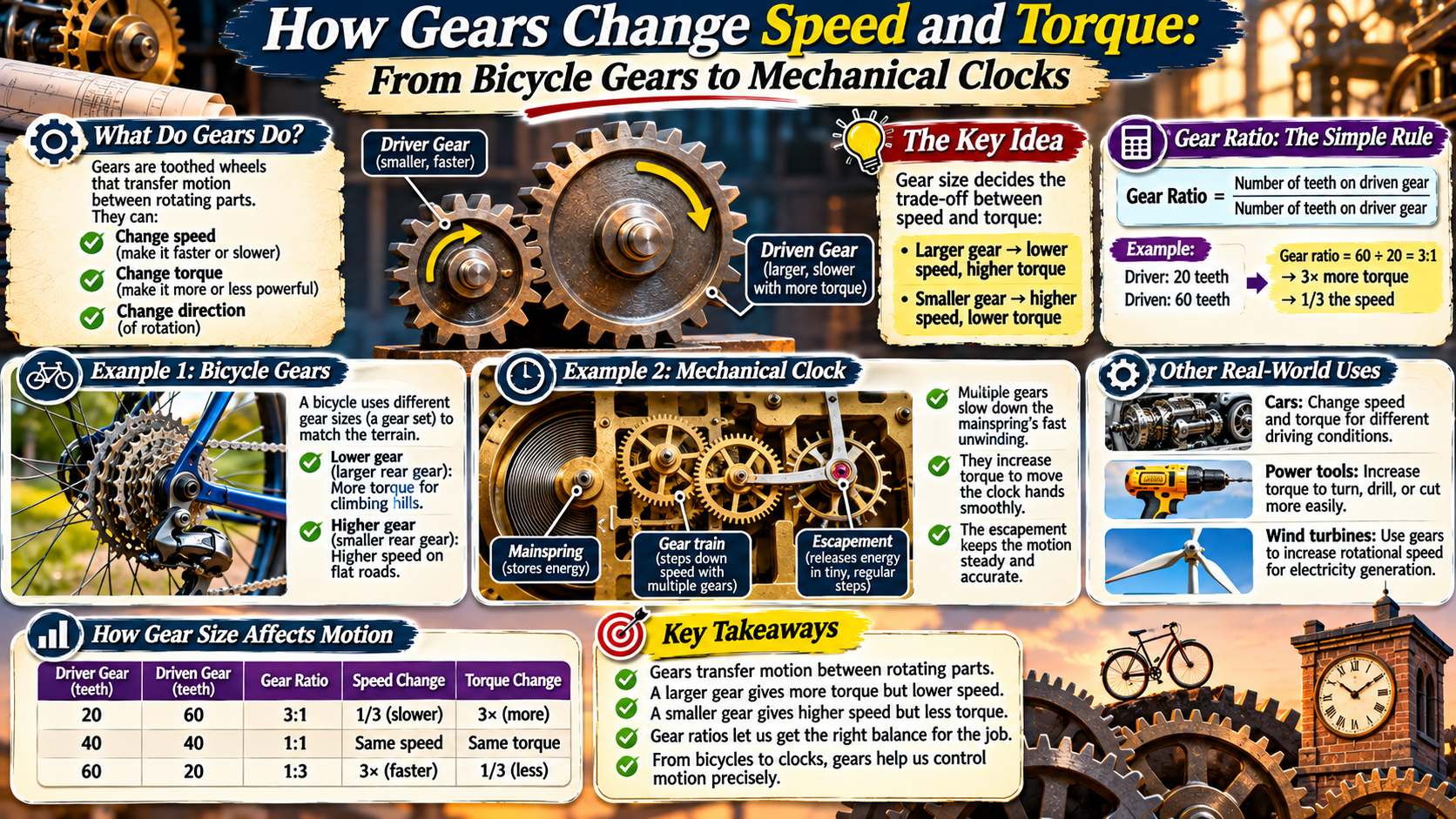
The Slicing of Infinity: The Mechanical Quest to Measure Time
Time flows as an unbroken, continuous river across the cosmos. Yet to coordinate human civilization, navigate treacherous oceans, synchronize railway networks, and execute billions of digital computations per second, humanity had to accomplish an extraordinary feat: we had to chop continuous time into identical, countable micro-slices.
Every timekeeping device ever constructed across human history—from the grand grandfather pendulum clock standing solemnly in a Victorian hallway, to the delicate Swiss mechanical wristwatch ticking on an executive’s wrist, to the microscopic quartz crystal vibrating in an iPhone—operates on the exact same universal engineering architecture: The Harmonic Oscillator coupled to a Counter and Display.
A clock does not measure time through magic; it sustains a physical system that vibrates back and forth with relentless mathematical consistency (an isochronous resonance frequency). It then increments a mechanical gear counter every time the resonator completes one full cycle. In this deep horological masterclass, we explore the mechanical physics of the anchor escapement, Christiaan Huygens’ pendulum kinematics, the microscopic hairspring balance wheel, the tourbillon anti-gravity carriage, and the piezoelectric quartz crystal oscillator that conquered modern timekeeping.
⏱️ The Longitude Problem and John Harrison
‘In the 18th century, calculating a ship\’s East-West longitude at sea required knowing the exact time at the Prime Meridian in Greenwich. Pendulum clocks stopped working on rolling ships. English carpenter and self-taught clockmaker John Harrison solved the greatest navigation crisis in history by inventing H4: a marine chronometer using a temperature-compensated balance wheel that lost just 5 seconds over an 81-day ocean voyage!’
The Harmonic Oscillator and Isochronism: Galileo’s Lamp
The dawn of precision timekeeping occurred in 1582 inside the Cathedral of Pisa. According to scientific history, a young Italian mathematician named Galileo Galilei sat watching a large incense chandelier swinging back and forth from the ceiling. Timing the swings against his own pulse, Galileo made an astonishing discovery: The period of a swinging pendulum is virtually independent of its amplitude (swing width)!
Whether the chandelier swung through a wide arc of ten feet or drifted down to a tiny whisper of six inches, each complete swing took precisely the exact same amount of time. This profound physical property is known as Isochronism (from the Greek: equal time).
For small angular displacements (typically under 5 degrees), the period ($T$) of a simple pendulum is governed strictly by the length of the suspension rod ($L$) and local gravitational acceleration ($g$):
T = 2 * pi * sqrt(L / g)
Notice what is missing from this equation: Mass! It does not matter whether the swinging pendulum bob weighs one ounce or one hundred pounds; its time period depends solely on length. To build a clock whose pendulum ticks once every exact second (a period of $T = 2.0$ seconds for a full back-and-forth swing), a clockmaker simply needs a pendulum rod tuned to a precise length of 0.994 meters (39.1 inches)—the legendary Seconds Pendulum.
| Timekeeping Technology | Primary Resonating Component | Natural Oscillation Frequency | Accuracy Drift Rate | Historical Era & Engineering Application |
|---|---|---|---|---|
| Verge & Foliot Clock | Horizontal weighted crossbar | ~0.5 to 1 Hz (highly erratic) | Gained/lost 15 to 30 minutes/day | 14th Century monasteries & public town towers |
| Pendulum Clock (Huygens) | Suspended rigid rod with brass bob | 0.5 Hz (T = 2.0 sec / 39.1 inch rod) | Accurate to within 10 to 15 seconds/week | 1656; transformed scientific astronomy & navigation |
| Deadbeat Escapement | Hardened steel anchor pallet arms | 0.5 Hz (eliminates recoil back-slip) | Accurate to within 1 second/month | 1715 (George Graham); standard regulator observatory clocks |
| Mechanical Watch | Balance wheel & flat Invar hairspring | 2.5 to 5 Hz (18,000 to 36,000 bph) | Accurate to within -4/+6 seconds/day (COSC) | 17th Century pocket watches to modern luxury Swiss wristwatches |
| Quartz Crystal Oscillator | Piezoelectric synthetic tuning fork | 32,768 Hz (2^15 cycles/second) | Accurate to within 15 seconds/month (0.5 sec/day) | 1969 Seiko Astron; universal modern electronic timekeeping |
| Cesium-133 Atomic Clock | Hyperfine atomic electron transition | 9,192,631,770 Hz microwave resonance | Loss of 1 second every 100,000,000 years | Global Positioning System (GPS) & UTC International time |
The Escapement Mechanism: The Beating Heart of Mechanical Clocks
While a free-swinging pendulum is an exceptional natural oscillator, it presents a fatal engineering challenge: Air friction and bearing resistance will cause the pendulum to slowly lose energy and come to a dead stop in a few minutes.
To keep the pendulum swinging indefinitely, the clock must solve two contradictory engineering requirements simultaneously:
- Energy Replenishment: The clock must provide a tiny mechanical push (impulse) to the pendulum on every single swing to replace the energy lost to friction.
- Count and Lock: The clock must prevent the mainspring or hanging driving weight from unwinding uncontrollably in five seconds, releasing the gear train by exactly one tooth per swing.
The mechanical genius that executes this miraculous dance is the Escapement. In a pendulum clock, the classic Anchor Escapement consists of an escape wheel with saw-like teeth driven by the clock’s falling weight, and a curved two-armed rocking anchor connected to the swinging pendulum:
- The Pallet Catch: As the pendulum swings to the left, the left pallet arm drops into the spinning escape wheel, locking against a tooth face and arresting gear rotation dead in its tracks.
- The Sliding Impulse: As the pendulum reverses its swing and passes through center equilibrium, the angled wedge face of the pallet slides across the escape tooth. The pressure of the driving gear train pushes the pallet outward, giving the pendulum a gentle, rhythmic mechanical kick!
- The Release (Escape): The instant the left pallet clears the tooth, the gear train spins forward by a fraction of a millimeter—until the right pallet arm drops into the teeth on the opposite side, catching the next tooth with that sharp, distinctive acoustic sound: TICK!
- The Second Half: On the return swing, the process repeats on the right pallet: catch, impulse, escape: TOCK!
🔔 The Acoustic Genesis of Tick-Tock
‘The iconic tick-tock sound of a clock is NOT the sound of gears turning. It is the violent acoustic impact shockwave generated when a high-speed hardened steel escape tooth crashes into the sapphire or ruby pallet stone, abruptly halting the rotational momentum of the entire gear train thousands of times an hour!’
The Balance Wheel and Hairspring: Miniaturizing Time for the Wrist
A pendulum clock is an immovable stationary machine: tilt it slightly, bump it, or put it on a moving carriage, and gravitational perturbation destroys its timekeeping accuracy. How did watchmakers miniaturize this massive apparatus into a tiny mechanical watch worn comfortably on a human wrist?
In 1675, Dutch scientist Christiaan Huygens invented the mechanical heart of portable watches: the Sprung Balance Wheel.
The balance mechanism replaces gravity with a torsion spring:
- The Glucydur Balance Wheel: A precisely balanced wheel mounted on polished jeweled synthetic ruby pivot bearings.
- The Hairspring (Balance Spring): A hair-thin spiral spring coiled tightly around the central balance staff. When the balance wheel rotates in one direction, it winds the spiral spring tighter. The spring exerts a restoring torque:
- Synthetic Ruby Jewel Bearings: At 28,800 beats per hour, the balance wheel pivots rotate over 250 million times a year. To prevent catastrophic friction wear, the steel balance pivots (measuring only 0.08 mm in diameter) ride inside synthetic sapphire or ruby doughnut bearings lubricated with microscopic droplets of synthetic micro-viscosity watch oils.
tau = -k * theta
This restoring torque forces the wheel to stop, reverse direction, unwind, swing through zero, and wind up in the opposite direction. The balance wheel acts as a rotary torsional pendulum, oscillating back and forth at high frequencies—typically 28,800 beats per hour (4 Hz / 8 ticks per second) in modern Swiss luxury calibers.
The Tourbillon: Defeating Gravity’s Positional Distortion
In 1795, Abraham-Louis Breguet invented what is widely regarded as the crowning complication of mechanical horology: the Tourbillon (French for ‘whirlwind’).
When a pocket watch sits vertically inside a gentleman’s vest pocket, gravity exerts an asymmetric downward pull on the microscopic hairspring and balance wheel. Gravity pulls the hairspring off-center, causing rate errors: the watch runs slightly faster in some positions and slower in others. Breguet solved this by mounting the entire escapement—the balance wheel, hairspring, pallet fork, and escape wheel—inside a rotating steel cage that revolves 360 degrees every 60 seconds:
- Positional Averaging: Because the regulating organ continuously spins through all 360 degrees of orientation, positional gravitational errors are canceled out dynamically! A rate error incurred while the hairspring hangs in the top quadrant is neutralized 30 seconds later as it passes through the bottom quadrant.
- Micro-Mechanical Architecture: A complete tourbillon cage assembly often weighs less than 0.3 grams, yet contains over 70 individual hand-beveled components fabricated from lightweight titanium, beryllium bronze, or silicon, rotating perpetually on tiny ceramic ball bearings.
The Automatic Self-Winding Mechanism: Harvesting Human Movement
A mechanical watch mainspring unwinds after 40 to 70 hours. To eliminate manual winding, horologists invented the Automatic Rotor Mechanism, pioneered in modern form by Rolex in 1931:
- The Heavy Inertial Oscillating Weight: Mounted on low-friction miniature ball bearings at the center of the movement is a semi-circular oscillating weight (rotor) crafted from dense, heavy metals—most often Solid 21k Gold or Sintered Heavy Tungsten Alloy.
- Kinetic Energy Harvesting: As the wearer moves their arm throughout the day, Earth’s gravity and wrist acceleration cause the heavy off-center rotor to swing freely in circles.
- Reversing Gear Kinematics: Through an ingenious system of twin reversing click wheels, rotation of the rotor in either direction (clockwise or counter-clockwise) is mechanically rectified into unidirectional rotation, winding the spiral spring steel mainspring inside the mainspring barrel.
- The Slipping Mainspring Bridle: If an automatic watch is worn continuously, why doesn’t the rotor over-wind and snap the mainspring? The outer end of the mainspring is not anchored rigidly to the barrel wall; it is attached to a curved spring-steel friction bridle. When fully wound, the bridle slips harmlessly along the greased interior barrel wall, preventing breakage through pure mechanical friction limits.
The Quartz Crystal Revolution: Piezoelectric Megahertz Resonance
In 1969, a historic technological earthquake shook the mechanical horology industry: Japanese watchmaker Seiko unveiled the Quartz Astron 35SQ—the world’s first commercial quartz wristwatch. Within five years, ultra-precise quartz watches costing twenty dollars outperformed multi-thousand-dollar hand-crafted Swiss mechanical chronometers by an order of magnitude. What makes quartz crystal timekeeping so astonishingly accurate?
The secret is the Piezoelectric Effect discovered in 1880 by Jacques and Pierre Curie:
- Piezoelectric Resonance: When a mechanical stress is applied to certain crystalline lattices (like silicon dioxide / quartz), an electric voltage appears across its faces. Conversely (the inverse piezoelectric effect), when an electrical voltage is applied across quartz, the crystal physically flexes and deforms!
- The 32,768 Hz Tuning Fork: Inside every modern quartz watch sits a microscopic synthetic quartz crystal laser-cut into the shape of a tiny two-pronged tuning fork, hermetically sealed inside a tiny metal cylinder. When a 1.5-Volt silver-oxide button battery applies an alternating micro-current to the crystal, it vibrates at an exact frequency of 32,768 Hertz (32,768 vibrations per second).
- The Power of 2 Binary Divider: Why was 32,768 chosen by electrical engineers? Because 32,768 is exactly two to the fifteenth power ($2^{15}$). The high-frequency electronic signal from the crystal passes through an integrated circuit containing a chain of 15 flip-flop binary digital dividers. Each divider stage cuts the frequency exactly in half: 32,768 –> 16,384 –> 8,192 … down to exactly 1.00000 Hertz (one pulse per second)!
- The Lavet Stepper Motor: That clean one-second digital pulse energizes a tiny bi-polar electromagnetic coil (a Lavet stepper motor), whose rotor snaps forward by 180 degrees once per second, turning the second hand forward with crisp, unerring digital precision.
Conclusion: The Poetry of Mechanical Symmetry
From the swinging brass pendulum rods of seventeenth-century cathedrals to the hyper-frequency piezoelectric tuning forks vibrating unseen on billions of wrists, human timekeeping represents the supreme convergence of physical mathematics, metallurgy, and kinematic design.
By capturing the natural harmonic frequencies of physical matter, buffering energy against frictional decay through escapement pulses, mitigating gravitational errors with rotating tourbillon cages, and translating oscillations into visual movements, horologists transformed the intangible, elusive passage of time into an observable, magnificent mechanical reality.