URBAN TRAFFIC ENGINEERING LAB / TRANSPORT SYSTEMS
The Hidden Timing Systems Behind Moving Traffic
Discover how modern intersections detect vehicles, manage competing movements, and synchronize green lights to keep roads operating safely and efficiently.
Have you ever driven along a city road and passed through several green traffic lights without stopping?
At other times, you may reach one red light after another, even when traffic appears relatively light.
These experiences are often connected to the way traffic signals are programmed and coordinated.
Modern traffic lights do much more than alternate between red, yellow, and green.
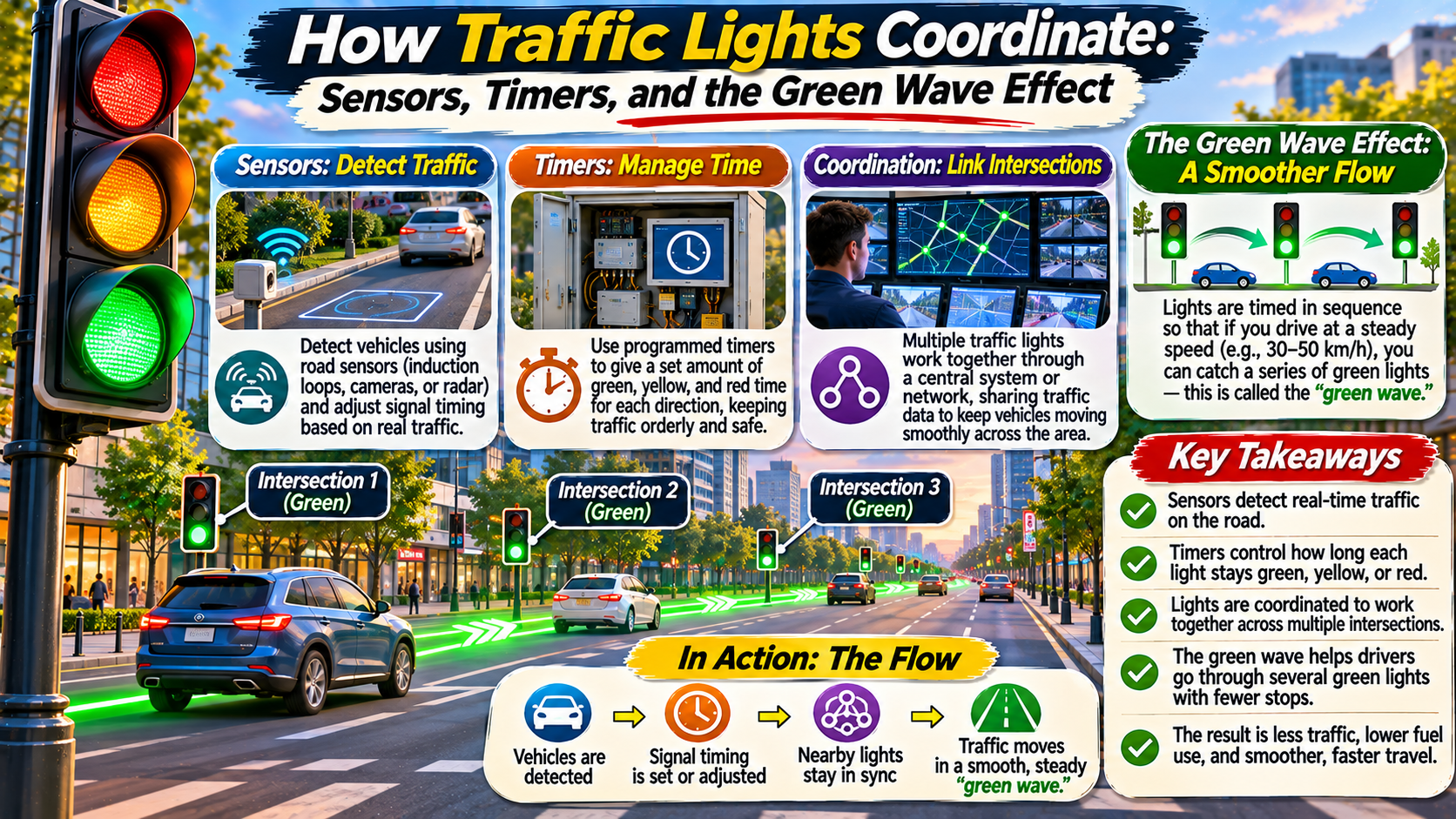
Many intersections use sensors to detect vehicles, timers to control signal changes, and communication systems to coordinate neighboring junctions.
Some systems even adjust their operation as traffic conditions change.
Traffic signal coordination is the process of managing signal timing across intersections to improve traffic flow while maintaining safe movements for vehicles, pedestrians, and cyclists.
Understanding how these systems work reveals the engineering behind everyday journeys through busy towns and cities.
Why Traffic Lights Need Coordination
Every signalized intersection must manage several competing movements.
Vehicles may travel straight ahead, turn left, or turn right.
Pedestrians need time to cross roads, while cyclists and public transport vehicles may require additional consideration.
If each intersection operates independently, drivers may repeatedly stop at red lights along the same road.
This can increase delays, fuel consumption, and vehicle queues.
Coordinated signals attempt to reduce unnecessary stopping by managing when green periods begin at neighboring intersections.
However, maximizing traffic flow is not the only objective.
Traffic engineers must also consider safety, pedestrian access, public transport, local traffic demand, and the capacity of connecting roads.
A well-designed system balances these competing needs rather than simply keeping one direction green for as long as possible.
The Basic Traffic Signal Cycle
Traffic lights generally operate through a repeating sequence of signal phases.
A phase allows one or more compatible traffic movements to proceed.
For example, vehicles traveling straight through an intersection may receive a green signal while conflicting traffic remains stopped.
The total time required to complete the programmed sequence is called the cycle length.
Cycle lengths vary depending on traffic demand, intersection design, pedestrian requirements, and local operating policies.
Some intersections use relatively short cycles to reduce waiting.
Busy intersections may require longer cycles to accommodate several turning movements and substantial traffic volumes.
The sequence also includes transition and clearance intervals.
These intervals help vehicles and pedestrians complete movements safely before conflicting traffic receives permission to proceed.
TRAFFIC CONTROL / CORE CONCEPT
A Signal Cycle Is More Than a Countdown.
It combines green time, transition intervals, clearance periods, and the sequence of permitted movements. Coordinated systems also control how each intersection’s cycle aligns with nearby signals.
Fixed-Time Traffic Lights: Following a Schedule
Fixed-time traffic signals operate according to predetermined timing plans.
Each movement receives a programmed amount of time within a repeating cycle.
The system does not necessarily change its timing in response to every arriving vehicle.
For example, a main road might receive a longer green period than a quieter side street.
Traffic engineers establish these timings using observations, traffic counts, and expected demand.
Some locations use different fixed-time plans during morning rush hour, afternoon traffic, evenings, or weekends.
Fixed-time operation can work well when traffic patterns are reasonably predictable.
However, it may be less efficient when actual traffic differs significantly from the expected conditions.
A quiet side street might receive green time even when no vehicles are waiting.
This limitation encouraged the development of vehicle-actuated signal control.
How Traffic Light Sensors Detect Vehicles
Many modern intersections use detectors to identify approaching or waiting vehicles.
These devices provide information that helps the signal controller decide when to begin, extend, or end certain phases.
Different detection technologies are suitable for different road conditions.
Inductive Loop Detectors
Inductive loops are electrical wire loops installed beneath the road surface.
When a vehicle passes over or stops above the loop, its metal components affect the loop’s electromagnetic properties.
Detector electronics recognize this change and send a signal to the traffic controller.
Inductive loops have been widely used because they can reliably detect vehicles when correctly installed and maintained.
However, installation and repairs may require cutting or disturbing the road surface.
Video Detection Cameras
Some intersections use cameras and image-processing software to detect vehicles.
The system analyzes selected areas of the camera view to determine whether vehicles are present or moving.
Video detection can cover multiple lanes without requiring detectors beneath every lane.
Performance depends on camera placement, lighting, weather, visibility, and the detection technology.
Vehicle detection cameras should not automatically be confused with enforcement cameras used to record traffic violations.
Radar and Other Sensors
Radar sensors use radio waves to detect vehicle movement or presence.
Some systems can estimate vehicle speed and track approaching traffic.
Other detection technologies include magnetometers and specialized infrared sensors.
Traffic engineers select equipment based on reliability, maintenance requirements, road layout, and the information needed by the control system.
What Happens When a Sensor Detects a Car?
A vehicle detector does not necessarily cause an immediate green light.
Instead, it sends information to the signal controller.
The controller evaluates that information against its programmed rules.
If a vehicle is waiting on a side street, the controller may register a request for that movement.
The current green phase may continue until a minimum green time has passed.
Other conditions, such as pedestrian crossing requirements or maximum green limits, may also affect the decision.
When the controller determines that it is appropriate, the signal transitions to another phase.
This allows the intersection to respond to demand while maintaining orderly and safe traffic movements.
Vehicle-Actuated Traffic Signals
Vehicle-actuated signals use detector information to adjust aspects of signal operation.
At a simple intersection, a side street may receive a green signal only when a vehicle is detected or another request is registered.
On the main road, the controller may extend a green period when vehicles continue arriving.
However, the extension is usually limited by programmed operating rules.
This prevents one movement from monopolizing the intersection indefinitely.
Actuated control can reduce unnecessary waiting when traffic demand varies.
Its effectiveness depends on accurate detection, suitable timing settings, and the overall intersection design.
What Is the Green Wave Effect?
The green wave effect occurs when traffic signals along a route are timed so that vehicles traveling at an intended speed can encounter a sequence of green lights.
Instead of stopping at every intersection, a group of vehicles may progress through several junctions with fewer interruptions.
This is achieved by coordinating the starting times of green periods.
The time difference between corresponding points in the cycles of neighboring intersections is called the offset.
Engineers calculate offsets using factors such as intersection spacing, expected travel speed, and signal cycle length.
When the timing is suitable, vehicles leaving one intersection can reach the next during its green period.
However, green waves are not guaranteed for every driver.
Turning vehicles, congestion, pedestrians, changing speeds, and other traffic movements can interrupt the progression.
SIGNAL COORDINATION / GREEN WAVE
Three Intersections. One Coordinated Journey.
Vehicles depart when the first signal turns green.
Its green period begins at a time designed to accommodate arriving traffic.
A further timing offset may allow the same group of vehicles to continue without stopping.
This is a simplified illustration. Real signal plans must also accommodate cross traffic, turning movements, and pedestrian crossings.
How Engineers Calculate Green Wave Timing
Imagine two intersections located 400 meters apart.
If vehicles travel at a steady 40 kilometers per hour, they cover approximately 11.1 meters each second.
At that speed, traveling 400 meters takes about 36 seconds.
Engineers may use this estimated travel time when selecting the offset between the intersections.
For example, they might arrange for the downstream green period to begin approximately 36 seconds after a suitable reference point at the upstream signal.
However, the real calculation is more complicated.
It must consider queue clearance, acceleration, turning traffic, signal phase order, and the green time available at each junction.
Coordination in both travel directions can also be difficult because the ideal offsets may conflict.
Consequently, a green wave is often optimized for a particular direction or traffic period rather than every movement simultaneously.
Why Green Waves Do Not Always Work Perfectly
Coordinated signals operate in real traffic conditions, which are rarely completely predictable.
A vehicle may travel faster or slower than the speed assumed in the timing plan.
Queues can delay vehicles before they leave an intersection.
Turning vehicles may enter the coordinated route at different points.
Pedestrian requests and transit priority systems can alter certain signal timings.
Traffic incidents, construction, and unusual demand may also affect progression.
For these reasons, engineers evaluate coordination using measures such as travel time, delay, number of stops, and queue length.
A successful signal plan improves overall performance rather than promising uninterrupted green lights for every journey.
Adaptive Traffic Signals: Responding to Changing Conditions
Adaptive traffic signal systems adjust their operation using information about current traffic conditions.
They may analyze traffic volumes, queues, or detector measurements across multiple intersections.
The system then modifies timing parameters to respond to changing demand.
For example, it may allocate additional green time to a heavily used route while maintaining service for other movements.
Some adaptive systems also modify cycle lengths or coordination offsets.
Well-known approaches include SCOOT, which has been used in the UK and elsewhere, and SCATS, which originated in Australia and has been deployed internationally.
These systems differ in their algorithms and operating methods.
Adaptive control can improve traffic performance under suitable conditions, but results depend on detector quality, system configuration, maintenance, and local traffic patterns.
Fixed-Time, Actuated, and Adaptive Signals Compared
| Feature | Fixed-Time | Actuated | Adaptive |
|---|---|---|---|
| Main principle | Predetermined timing plan | Responds to detector requests | Adjusts timing using traffic data |
| Vehicle detection | Not always required | Usually important | Generally central to operation |
| Flexibility | Limited within each plan | Responds to local demand | Can respond across a network |
| Typical use | Predictable traffic patterns | Variable intersection demand | Complex or changing networks |
How Pedestrian Crossings Fit into Signal Coordination
Traffic signal systems must accommodate pedestrians as well as vehicles.
At some intersections, pedestrians press a button to request a crossing phase.
Other locations provide pedestrian crossing opportunities automatically during each cycle.
The controller must allow suitable crossing time based on the road layout and applicable design standards.
Pedestrian phases may affect the amount of green time available to vehicles.
They can also influence coordination between nearby intersections.
However, pedestrian safety and accessibility requirements cannot simply be ignored to maintain a green wave.
Traffic engineers therefore design coordination plans around the needs of all road users.
How Buses and Emergency Vehicles Receive Priority
Some traffic signal systems can give priority to selected vehicles.
Transit signal priority may help buses maintain schedules or reduce delays.
Depending on the system, a bus approaching an intersection may request a longer green period or an earlier return to green.
Emergency vehicle preemption is a different type of control.
It may temporarily change the normal signal sequence to help an authorized emergency vehicle pass through an intersection.
These functions require careful safety controls and appropriate detection or communication equipment.
They may also temporarily interrupt ordinary traffic coordination.
After the priority event ends, the controller returns toward its normal operating plan.
How Traffic Signals Communicate Across a City
Coordinated intersections may be connected through communication networks.
Depending on the installation, these connections can use fiber-optic cables, other wired infrastructure, or wireless technologies.
A central traffic management system may monitor signal status and distribute timing plans.
Some controllers coordinate locally using shared timing references.
Others receive instructions or adjustments from a central system.
Traffic management centers can also monitor equipment faults and unusual congestion.
Reliable communication and maintenance are important because faulty detectors or incorrect settings can reduce the effectiveness of coordination.
Can Smart Traffic Lights Eliminate Congestion?
Smart signal systems can improve how existing road space is used, but they cannot eliminate every traffic problem.
An intersection has a limited capacity.
When the number of vehicles exceeds that capacity, queues can continue growing even with efficient signal timing.
Congestion may also result from crashes, roadworks, poor junction design, or bottlenecks farther along a route.
Signal coordination can reduce avoidable delays and improve traffic progression.
However, it cannot create unlimited road capacity.
Effective urban transport planning often combines signal management with public transport, safe walking and cycling infrastructure, and broader network improvements.
Why Traffic Lights Sometimes Stay Red When No Cars Are Coming
Drivers occasionally encounter a red signal even when the crossing road appears empty.
Several factors can explain this behavior.
The intersection may be following a fixed-time coordination plan.
A pedestrian crossing request may be active.
The controller may be completing a minimum green or clearance interval.
Another possibility is that a detector has failed or is not registering vehicles correctly.
Some systems also maintain specific timing relationships with neighboring intersections.
Therefore, an apparently unnecessary red light does not automatically indicate that the signal is malfunctioning.
Drivers should always obey the displayed signal and applicable traffic laws.
Frequently Asked Questions
How do traffic lights know when a car is waiting?
Many intersections use inductive loops, cameras, radar, or other sensors to detect vehicles and send information to the signal controller.
What is the green wave effect?
It is the coordination of traffic signal timings so that vehicles traveling at an intended speed can pass through several intersections with fewer stops.
Are all traffic lights controlled by sensors?
No. Some signals follow fixed-time plans, while others use vehicle-actuated or adaptive control systems.
Can traffic lights communicate with each other?
Yes. Coordinated systems may use communication networks or shared timing references to align signal operation across multiple intersections.
Why do some traffic lights turn green faster than others?
Differences in traffic demand, detector requests, pedestrian requirements, and programmed timing rules can affect how quickly a signal changes.
Do green waves work in both directions?
They can be designed to support both directions, but achieving equally effective progression in each direction is often difficult.
Can adaptive traffic lights reduce congestion?
They can improve traffic flow under suitable conditions, but they cannot eliminate congestion when demand exceeds road capacity.
Final Thoughts
Traffic lights are part of a coordinated engineering system that manages how people and vehicles move through road networks.
Fixed-time controllers follow predetermined schedules.
Vehicle-actuated signals use sensors to respond to local traffic demand.
Adaptive systems can adjust timing across larger networks as conditions change.
The green wave effect demonstrates how carefully selected signal offsets can help vehicles travel through several intersections with fewer stops.
However, effective traffic management must also consider pedestrians, cyclists, buses, emergency vehicles, and conflicting traffic movements.
No signal system can eliminate every delay, but thoughtful coordination can improve the reliability and efficiency of urban travel.
The next time you pass through several green lights in succession, remember that the experience may be the result of carefully planned timing rather than simple luck.