APPLIANCE ENGINEERING LAB · EVERYDAY SCIENCE
A Refrigerator Doesn’t Create Cold. It Moves Heat.
Explore the surprisingly clever system that keeps food cold by carrying heat from inside your refrigerator into the surrounding room.
Open your refrigerator, and you immediately feel cool air. Food stays fresh longer, drinks remain chilled, and frozen items stay solid in the freezer.
But have you ever wondered how a refrigerator actually makes its interior cold?
The answer is more interesting than it first appears.
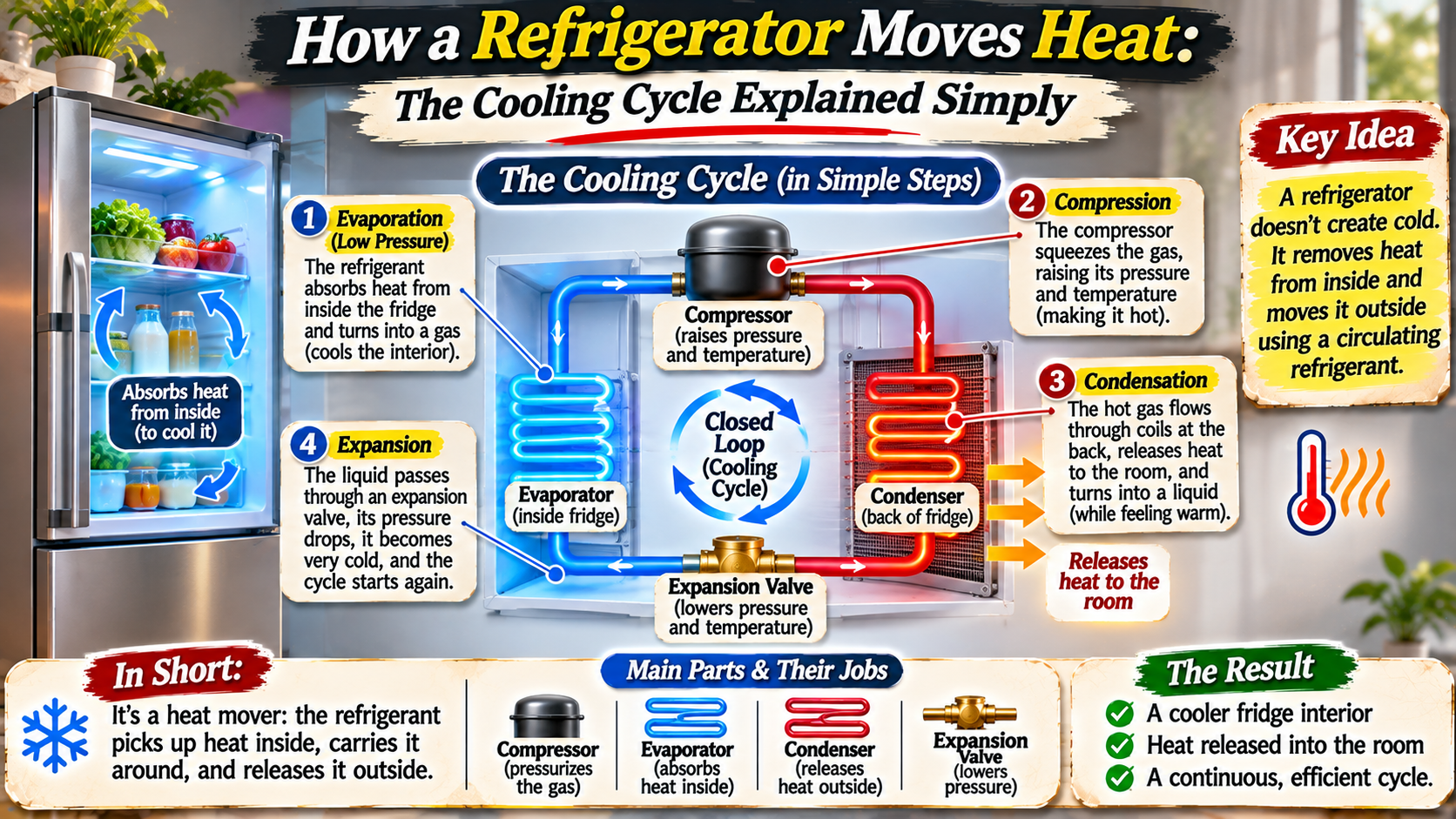
A refrigerator does not manufacture cold air. Instead, it removes heat from an enclosed space and releases that heat into the surrounding room.
This process happens through a continuous system known as the vapor-compression refrigeration cycle.
The cycle uses a special fluid called a refrigerant, along with a compressor, condenser, expansion device, and evaporator.
These components work together to transfer heat from the refrigerator’s interior to the outside environment.
Understanding the process reveals how one of the most useful household appliances applies basic principles of physics and thermodynamics.
The Basic Idea: Heat Naturally Moves from Warm to Cold
Heat naturally flows from a warmer object or region toward a cooler one.
For example, a cold drink left on a kitchen counter gradually warms as heat enters it from the surrounding air.
A refrigerator must work against this natural tendency.
Its interior is colder than the kitchen, yet heat must be moved from the colder compartment into the warmer room.
This requires an input of energy.
Most household refrigerators use electricity to power a compressor that makes the heat-transfer cycle possible.
The refrigerant circulates through the system, absorbing heat in one location and releasing it in another.
The refrigerator therefore operates as a heat pump designed primarily to cool an enclosed space.
CORE SCIENCE PRINCIPLE
Cooling Means Removing Heat, Not Producing Cold.
A refrigerator uses electrical energy to move thermal energy from its cold interior to the warmer surrounding environment.
The Four Main Parts of a Refrigerator Cooling System
A conventional vapor-compression refrigerator relies on four essential components.
Each performs a different task as the refrigerant travels through the cooling circuit.
REFRIGERATION SYSTEM / COMPONENT OVERVIEW
Raises refrigerant vapor pressure and temperature.
Releases heat into the surrounding environment.
Reduces refrigerant pressure before cooling.
Absorbs heat from inside the refrigerator.
Step 1: The Compressor Raises Pressure and Temperature
The cooling cycle can be explained by starting at the compressor.
The compressor is commonly located near the bottom of the refrigerator, often toward the rear.
It receives low-pressure refrigerant vapor returning from the evaporator.
The compressor squeezes this vapor into a smaller volume.
As the vapor is compressed, its pressure and temperature rise.
The refrigerant leaves the compressor as a hot, high-pressure vapor.
This high temperature is important because the refrigerant must become hotter than the surrounding room air to release heat efficiently.
The compressor is one of the main electricity-consuming components of the refrigeration system.
Depending on the refrigerator’s design, it may operate at a fixed speed or use variable-speed technology.
Variable-speed compressors can adjust their output to changing cooling demands.
Why Compression Is Necessary
Without compression, the refrigerant would not have the pressure and temperature conditions needed to release heat effectively through the condenser.
The compressor helps establish the high-pressure side of the system.
This creates the conditions required for the refrigerant to reject heat outside the refrigerator.
Step 2: The Condenser Releases Heat into the Room
After leaving the compressor, the hot refrigerant enters the condenser.
The condenser is a heat exchanger that transfers heat from the refrigerant to the surrounding environment.
In some refrigerators, condenser coils are visible on the back.
Other models use condenser tubing integrated into the cabinet or located near the bottom of the appliance.
As heat leaves the refrigerant, the hot vapor cools and condenses into liquid.
During condensation, the refrigerant releases a significant amount of thermal energy.
This is why parts of a refrigerator’s exterior or condenser area may feel warm during operation.
The refrigerator is releasing the heat removed from its interior, along with the energy added by the compressor.
Why the Back or Sides of a Refrigerator Feel Warm
Warm exterior surfaces are often a normal result of refrigeration.
The appliance must reject heat somewhere, and the surrounding room serves as the destination.
However, excessive heat, poor cooling, or unusual noises may indicate a problem that requires professional inspection.
Step 3: The Expansion Device Reduces Refrigerant Pressure
After leaving the condenser, the refrigerant is generally a high-pressure liquid.
It then passes through an expansion device.
Many household refrigerators use a narrow capillary tube for this purpose.
The expansion device restricts refrigerant flow and produces a substantial pressure drop.
As pressure falls, some of the liquid refrigerant flashes into vapor.
The resulting mixture becomes much colder.
This prepares the refrigerant to absorb heat inside the refrigerator.
The expansion process is essential because the refrigerant must reach a sufficiently low temperature before entering the evaporator.
It is important to understand that the expansion device does not create cold energy.
Instead, it changes the refrigerant’s pressure and thermodynamic state so that heat absorption becomes possible.
Step 4: The Evaporator Absorbs Heat from Inside
The cold, low-pressure refrigerant enters the evaporator.
The evaporator is another heat exchanger, but its purpose is the opposite of the condenser.
Instead of releasing heat, it absorbs heat from the refrigerator’s interior.
Warm air inside the compartment transfers energy to the colder evaporator surface.
As the refrigerant absorbs heat, it boils and changes from liquid to vapor.
This phase change allows the refrigerant to absorb substantial thermal energy.
Fans may circulate compartment air across the evaporator and distribute cooled air through the appliance.
Other refrigerator designs rely more heavily on natural air circulation.
After leaving the evaporator, the low-pressure refrigerant vapor returns to the compressor.
The cycle then repeats.
REFRIGERATION CYCLE / SIMPLIFIED FLOW
Low-pressure vapor becomes hot, high-pressure vapor.
↓
Heat leaves the refrigerant, and vapor condenses into liquid.
↓
Pressure drops, producing a cold refrigerant mixture.
↓
Refrigerant absorbs heat from inside and returns as vapor.
↺ VAPOR RETURNS TO THE COMPRESSOR
What Is Refrigerant, and Why Is It Important?
Refrigerant is the working fluid that circulates through the cooling system.
Its physical properties allow it to absorb and release heat at useful temperatures and pressures.
The refrigerant repeatedly changes between liquid and vapor during normal operation.
These phase changes are central to the cooling process.
Different refrigerators use different refrigerants depending on equipment design, regulations, and manufacturing requirements.
Many modern household refrigerators use R-600a, also known as isobutane.
Some systems use other refrigerants.
Refrigerants differ in environmental impact, operating characteristics, and safety requirements.
For example, R-600a is flammable, so systems using it require appropriate engineering and servicing procedures.
Refrigerant circuits should not be opened or repaired by untrained individuals.
Why a Refrigerator Needs Electricity
A refrigerator uses electricity primarily to operate its compressor and supporting components.
Fans, controls, interior lights, and automatic defrost systems may also consume energy.
The compressor provides the mechanical work required to maintain the pressure difference between the high-pressure and low-pressure sides of the refrigeration system.
Without that pressure difference, the refrigerant could not continuously absorb heat inside and release it outside under the required conditions.
Electricity therefore enables the transfer of heat from a colder region to a warmer one.
This is consistent with the laws of thermodynamics because the refrigerator receives external energy to perform the process.
How the Thermostat Controls Cooling
A refrigerator does not need to run its compressor at maximum output continuously.
Temperature sensors or thermostatic controls monitor conditions inside the appliance.
When the compartment becomes warmer than the desired temperature range, the control system calls for additional cooling.
In a conventional fixed-speed refrigerator, this usually causes the compressor to start.
Once the temperature reaches the control system’s target, the compressor may switch off.
Variable-speed systems can adjust compressor operation more gradually.
This control helps maintain suitable food-storage temperatures while limiting unnecessary electricity consumption.
Why Refrigerator Doors and Insulation Matter
The refrigeration cycle removes heat, but the refrigerator’s cabinet helps slow the rate at which heat enters.
Insulation reduces heat transfer through the walls.
Door gaskets create a seal that limits warm-air leakage.
When the door opens, warmer room air enters the compartment.
The cooling system must then remove the additional heat.
Frequent door openings, damaged seals, and poor insulation can increase the refrigerator’s workload.
Hot food placed inside the compartment also adds heat that must be removed.
Good cabinet design and proper use therefore contribute to energy efficiency.
Refrigerator vs. Freezer: How Are They Different?
Refrigerators and freezers rely on the same basic heat-transfer principles.
The main difference is the temperature they are designed to maintain.
A refrigerator compartment is typically kept above the freezing point of water.
A freezer operates at substantially lower temperatures to keep food frozen.
Many combined refrigerator-freezer appliances use a shared refrigeration system with airflow controls to maintain different compartment temperatures.
Other designs use separate evaporators or additional control features.
The underlying process remains the same: heat is absorbed from the colder compartments and released into the surrounding environment.
Main Refrigeration Components Compared
| Component | Main Function | Refrigerant Condition |
|---|---|---|
| Compressor | Raises pressure and temperature | Low-pressure vapor becomes hot, high-pressure vapor |
| Condenser | Releases heat outside | High-pressure vapor condenses into liquid |
| Expansion device | Reduces pressure | High-pressure liquid becomes a cold, low-pressure mixture |
| Evaporator | Absorbs heat inside | Low-pressure refrigerant evaporates into vapor |
Why Refrigerators Sometimes Develop Frost
Frost forms when moisture in the air freezes on sufficiently cold surfaces.
When warm, humid air enters a refrigerator or freezer, water vapor may condense and freeze on the evaporator or nearby surfaces.
In some appliances, frost accumulation can reduce airflow and interfere with heat transfer.
Many modern frost-free refrigerators use automatic defrost systems.
These systems periodically warm the evaporator enough to remove accumulated frost.
The resulting water drains away and is typically evaporated outside the refrigerated compartment.
Excessive frost may indicate a door-seal problem, frequent air leakage, or a malfunctioning defrost system.
Simple Ways to Improve Refrigerator Efficiency
Proper maintenance and everyday habits can help a refrigerator operate efficiently.
Keep door seals clean and check that they close properly.
Avoid leaving the refrigerator door open longer than necessary.
Follow the manufacturer’s recommendations for ventilation clearance.
Where accessible and recommended by the manufacturer, clean dust from condenser surfaces using safe procedures.
Do not block internal airflow vents with food containers.
Use appropriate temperature settings rather than making the refrigerator unnecessarily cold.
For food safety, the U.S. Food and Drug Administration recommends keeping refrigerators at or below 40°F (4°C) and freezers at 0°F (-18°C).
A separate appliance thermometer can help verify compartment temperatures.
Common Cooling Problems and Possible Causes
If a refrigerator is not cooling properly, several factors may be responsible.
A damaged door gasket may allow warm air to enter.
Blocked internal vents can prevent cooled air from circulating effectively.
Dust accumulation on accessible condenser surfaces may reduce heat rejection.
Problems with fans, temperature controls, or the automatic defrost system can also affect performance.
More serious issues may involve the compressor or sealed refrigerant circuit.
Because refrigerants can present fire, pressure, and environmental hazards, sealed-system repairs should be handled by qualified technicians.
Basic checks such as confirming power, temperature settings, and door closure are reasonable starting points.
Frequently Asked Questions
Does a refrigerator create cold air?
No. A refrigerator removes heat from its interior and transfers that heat to the surrounding environment.
What are the four main parts of the refrigeration cycle?
The four essential components are the compressor, condenser, expansion device, and evaporator.
Why does a refrigerator need a compressor?
The compressor raises refrigerant pressure and temperature, allowing the refrigerant to release heat through the condenser.
Why does the back of a refrigerator get warm?
The condenser releases heat removed from the refrigerator’s interior, along with energy added by the compressor.
What does refrigerant do?
Refrigerant circulates through the system, absorbing heat in the evaporator and releasing it through the condenser.
Does a refrigerator run continuously?
Many refrigerators cycle their compressors on and off, while variable-speed systems can adjust operation according to cooling demand.
What temperature should a refrigerator maintain?
For food safety, refrigerator temperatures should be kept at or below 40°F (4°C), while freezers should be maintained at 0°F (-18°C).
Final Thoughts
A refrigerator is a practical example of thermodynamics at work.
Rather than creating cold, it uses electrical energy to move heat from its interior into the surrounding room.
The compressor raises refrigerant pressure and temperature.
The condenser releases heat to the environment.
The expansion device lowers refrigerant pressure.
The evaporator absorbs heat from inside the appliance.
These four components work together in a repeating cycle that maintains the cool temperatures needed for food storage.
Insulation, door seals, temperature controls, and airflow systems help the process operate efficiently.
Once you understand the refrigeration cycle, the appliance becomes much less mysterious.
Every time the compressor runs, it is helping transfer heat from one place to another—keeping your food cold through a carefully engineered cycle of pressure changes and heat exchange.