The Thermodynamic Paradox: Creating Cold by Moving Heat
In the physical universe governed by the fundamental laws of thermodynamics, there is no such physical substance as ‘cold’. Cold does not exist as an independent entity; cold is merely the absence of thermal energy. Just as darkness is the absence of photons and a vacuum is the absence of matter, cooling an object does not involve pumping cold into it; it requires the active, energetic physical extraction of heat from inside a thermal enclosure and expelling that heat into the surrounding ambient environment.
Yet according to the unyielding Second Law of Thermodynamics, heat flows spontaneously only in one direction: from a hotter body to a colder body (down a thermal gradient). Heat never flows spontaneously uphill from a cold compartment into a warm kitchen. To force thermal energy to flow against its natural thermodynamic gradient, humanity engineered one of the most brilliant mechanical systems in domestic history: the Vapor-Compression Refrigeration Cycle.
Every single domestic refrigerator humming quietly in modern kitchens is a closed-loop thermodynamic heat pump. Operating continuously for fifteen to twenty years without maintenance, it exploits the latent heat of vaporization of specialized chemical refrigerants, phase-change thermodynamics, reciprocating compressor physics, and fluid expansion mechanics to preserve global food supplies, prevent deadly bacterial proliferation, and sustain modern urban civilization. In this comprehensive mechanical engineering masterclass, we trace the complete four-stage thermodynamic journey of the refrigerant molecule.
❄️ The Second Law of Thermodynamics (Clausius Formulation)
‘Heat cannot spontaneously flow from a colder body to a warmer body without the expenditure of external mechanical work.’ — Rudolf Clausius (1850). The refrigerator electric compressor provides the external mechanical work that forces thermal energy uphill.
The Four Pillars of the Vapor-Compression Cycle
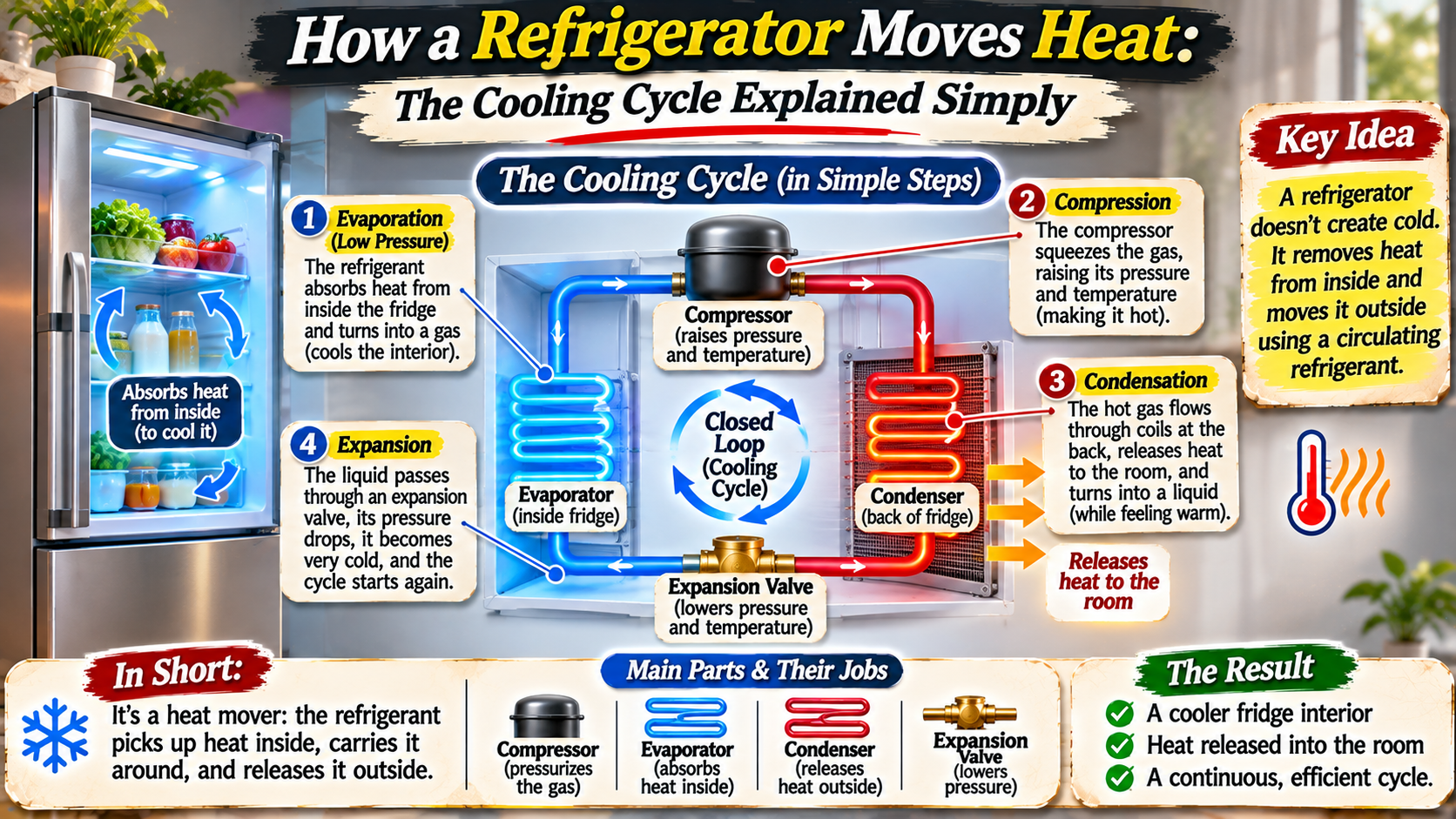
The vapor-compression refrigeration cycle operates as a continuous closed-loop thermodynamic circuit comprising four primary mechanical components, connected by sealed copper or aluminum tubing:
- The Mechanical Compressor: The energetic heart of the system. An electrically driven reciprocating piston or rotary scroll compressor draws low-pressure, low-temperature refrigerant vapor from the evaporator, compresses it mechanically, and discharges it as superheated, high-pressure vapor.
- The Condenser Coils: Located on the back or bottom underside of the refrigerator. As the superheated high-pressure vapor flows through serpentine metal coils, it rejects heat to the ambient room air (aided by natural convection or a small fan). The loss of thermal energy forces the refrigerant vapor to condense into a high-pressure liquid.
- The Expansion Device (Capillary Tube or Thermal Expansion Valve): A severe restriction in the fluid line (an ultra-narrow copper capillary tube with an internal bore less than 0.8 mm). It creates a sudden, massive pressure drop, causing the high-pressure liquid refrigerant to flash-evaporate into a freezing, low-pressure two-phase liquid-vapor mixture.
- The Evaporator Coils: Located inside the freezer and refrigerator compartments. As the icy cold, low-pressure liquid flows through the evaporator, it absorbs thermal energy from the stored food, boiling the refrigerant liquid back into a vapor at constant low temperature via latent heat of vaporization. The vapor then returns to the compressor, completing the infinite cycle.
| Refrigeration Stage | Mechanical Component | Refrigerant Physical State | Pressure & Temperature Profile | Thermodynamic Process |
|---|---|---|---|---|
| Stage 1: Compression | Hermetic reciprocating compressor | Superheated vapor | Low P / Low T –> High P / High T (up to 90°C) | Isentropic compression (work input: W_in) |
| Stage 2: Condensation | Exterior serpentine condenser coils | Phase change: Vapor to Liquid | High P / Decreasing T (heat rejected to room) | Isobaric heat rejection (Q_out to kitchen) |
| Stage 3: Expansion | Copper capillary tube (0.8mm bore) | Flash phase: Liquid to 2-phase mixture | High P / Ambient T –> Low P / Freezing T (-25°C) | Isenthalpic throttling expansion (Joule-Thomson) |
| Stage 4: Evaporation | Internal cabinet evaporator coils | Phase change: Liquid boils to Vapor | Low P / Low T (absorbing heat from food) | Isobaric heat absorption (Q_in from cabinet) |
| Defrost Cycle | Electric nichrome heating element | Periodic scheduled bypass | Heats evaporator to +4°C for 20 mins | Melts accumulated atmospheric ice frost |
Phase Change Thermodynamics: The Magic of Latent Heat
Why does a refrigerator utilize a circulating chemical refrigerant that constantly boils and condenses, rather than simply blowing cold compressed air? The answer lies in the monumental physical difference between Sensible Heat and Latent Heat.
Sensible heat is the thermal energy that causes a substance’s temperature to rise or fall without changing its state of matter. Heating liquid water from 10°C to 20°C requires 4.184 Joules per gram per degree Celsius. However, when water reaches its boiling point at 100°C, transforming that liquid water into steam vapor requires a staggering 2,260 Joules per gram—the Latent Heat of Vaporization—absorbed at a perfectly constant temperature without rising a single fraction of a degree!
Refrigeration engineers harness this enormous latent thermodynamic reservoir. Modern domestic refrigerators utilize Isobutane (R-600a)—an eco-friendly, zero-ozone-depletion hydrocarbon refrigerant (formula C4H10) with a normal boiling point of -11.7°C (10.9°F) at standard atmospheric pressure. When the pressure inside the evaporator coils is reduced by the compressor suction down to approximately 0.5 bar, R-600a boils at an icy -25°C (-13°F). As it boils inside the freezer walls, each gram of isobutane absorbs hundreds of Joules of thermal energy directly from your ice cream and vegetables, transforming heat extraction into an ultra-dense, compact thermodynamic process.
The Capillary Tube and the Joule-Thomson Effect: The Cold Flash
How does a warm, room-temperature liquid refrigerant suddenly transform into a sub-zero, bone-chilling fluid without any moving parts or electrical refrigeration chips? The mechanical secret is the Capillary Tube Expansion Device and the physics of the Joule-Thomson Throttling Effect.
Between the exterior condenser coils and the interior evaporator coils sits a slender copper capillary tube, typically two to three meters long with an internal bore diameter of only 0.6 mm to 0.8 mm (0.025 to 0.031 inches). As the high-pressure liquid refrigerant (pressurized to 8 to 10 bar) is forced through this microscopic fluid restriction, it encounters intense hydraulic frictional resistance. The fluid undergoes a violent, isenthalpic pressure drop (dropping from 10 bar down to 0.5 bar):
According to the Clausius-Clapeyron relation of thermodynamics, a liquid’s boiling temperature is a direct mathematical function of pressure. Drop the pressure, and the boiling point collapses. At 10 bar, isobutane requires 50°C to boil; at 0.5 bar, its boiling point plummets to -25°C! Because the entering liquid is at +30°C, it suddenly finds itself 55 degrees above its new boiling point. A fraction of the liquid instantly flash-evaporates into vapor; the latent heat required for this flash vaporization is stolen directly from the remaining liquid itself, causing the temperature of the fluid stream to crash to -25°C in a split second as it enters the evaporator coils.
🌡️ The Throttling Miracle
‘The capillary tube is pure fluid mechanics: zero moving parts, zero wires. By forcing high-pressure liquid through an 0.8mm restriction, fluid friction collapses the pressure, and thermodynamic phase physics crashes the temperature to -25°C instantly.’
The Hermetic Reciprocating Compressor: Engineering an Indestructible Heart
The sole active kinetic machine in a domestic refrigerator is the Hermetic Sealed Compressor—the black, steel dome-shaped canister nestled in the bottom rear compartment. It is called ‘hermetic’ because the electric motor, crankshaft, connecting rod, piston, and suction/discharge reed valves are all welded permanently inside a thick, airtight steel shell, submerged in specialized synthetic polyolester (POE) or mineral lubricating oil.
The engineering requirements of the hermetic compressor are monumental:
- Zero Shaft Seals: In an automotive air conditioning compressor, the driveshaft extends through a rubber seal to the engine belt; over years, refrigerant molecules inevitably leak past the shaft seal. In a domestic refrigerator, having a shaft penetrate the casing would guarantee refrigerant leaks. Instead, the electric motor stator and rotor are sealed inside the refrigerant gas itself! The cool returning suction refrigerant vapor washes directly over the motor windings, cooling the electrical copper coils while being compressed.
- Acoustic Isolation Springs: Inside the steel outer dome, the entire cast-iron motor and reciprocating piston assembly is suspended on three tuned steel coil springs. When the single-cylinder piston accelerates back and forth at 3,000 RPM (50 Hz), mechanical vibration is absorbed entirely by the internal suspension springs, preventing vibration from transmitting to the outer shell, keeping refrigerator acoustic hum below 38 dBA.
- Self-Acting Reed Valves: Precision-stamped Swedish flapper reed valves (fabricated from high-fatigue spring steel 0.1 mm thick) open and close automatically based on microscopic pressure differentials across the cylinder head, flexing millions of times per year without fatigue failure.
The Inverter Revolution: Variable Speed Brushless DC Motors
Traditional refrigerators employed a crude, binary control scheme: an on-off induction motor. Whenever internal temperatures drifted above a preset threshold, the compressor switched on at 100% full speed, running at maximum electrical wattage until the thermostat satisfied, and then abruptly cutting power. This stop-and-start duty cycle suffered from major inefficiencies: large inrush starting currents, temperature fluctuations of 3 to 4 degrees Celsius inside the food cabinet, and high mechanical wear on valves during startup torque spikes.
Modern high-efficiency refrigerators have completely replaced single-speed motors with Digital Inverter Compressors. An inverter compressor employs a Permanent Magnet Brushless DC (BLDC) Motor driven by a microprocessor-controlled Pulse-Width Modulation (PWM) variable frequency inverter drive. Instead of cycling violently between zero and 100%, the inverter compressor dynamically throttles its rotational speed across a smooth operational spectrum from 1,000 RPM to 4,500 RPM:
- Thermal Load Tracking: When warm leftovers or fresh room-temperature groceries are loaded into the refrigerator, the sensor array detects the thermal spike and ramps the motor up to 4,200 RPM for rapid pulldown cooling.
- Sustained Low-Frequency Cruising: During quiet night hours when the refrigerator door remains shut, the compressor hums gently at a whisper-quiet 1,100 RPM, consuming as little as 25 to 40 Watts of electrical power—less power than an ordinary incandescent light bulb.
- Coefficient of Performance (COP) Maximization: Running a refrigeration cycle slowly with lower mass flow rates dramatically reduces frictional pressure drops in piping and allows heat exchangers to operate with smaller temperature differences across coil walls, boosting the thermodynamic Coefficient of Performance by up to 40% compared to legacy on-off systems.
Frost-Free Engineering: The Automated Defrost Cycle
Prior to the 1970s, domestic refrigerators suffered from a hated domestic chore: manual defrosting. Every time the refrigerator door is opened, warm, humid room air enters the cabinet. As this humid air contacts the sub-zero evaporator coils, the water vapor desorbs and freezes instantly into crystalline frost. Within weeks, thick ice choked the evaporator coils, acting as an insulating blanket that blocked heat transfer and choked the airflow fan.
Modern refrigerators are 100% Frost-Free (Automatic Defrost), governed by electro-mechanical or microprocessor defrost timers:
- Continuous Air Circulation: The evaporator coils are concealed behind the rear freezer wall. A small brushless DC fan circulates cold air continuously between the freezer and fresh food compartments through automated plastic dampers.
- The Defrost Cycle Initiation: Every 8 to 12 hours of compressor run time, the control board halts the compressor and fan, and energizes a 500-Watt Nichrome Electric Heating Element clamped directly to the aluminum evaporator fins.
- Bimetallic Termination Thermostat: The heater warms the evaporator coils to +4°C, melting all accumulated ice into water droplets in under fifteen minutes. The melt water drains through a PVC tube down to a shallow drain pan sitting directly on top of the warm compressor dome in the bottom compartment; heat rejected by the compressor naturally evaporates the water into room air. A bimetallic safety thermostat detects when the coil reaches +8°C, snapping off the heater to prevent warming the food, and the refrigeration cycle restarts.
Thermodynamic Diagnostics: Understanding Subcooling, Superheat, and Failures
When professional HVAC/R technicians evaluate a refrigeration system’s mechanical health, they rely on two fundamental thermodynamic diagnostic parameters: Superheat and Subcooling.
Superheat measures how many degrees the refrigerant vapor temperature rises above its boiling point before entering the compressor suction port. If the superheat is zero degrees, it means liquid refrigerant droplets have failed to evaporate and are entering the compressor cylinder—a catastrophic failure condition known as liquid slugging that destroys steel reed valves and fractures connecting rods because liquids are incompressible. Proper evaporator tuning guarantees 4°C to 8°C of superheat, ensuring 100% pure gaseous dry vapor reaches the suction inlet.
Subcooling measures how many degrees the liquid refrigerant cools below its condensing saturation temperature before entering the capillary tube. If subcooling is absent, vapor bubbles enter the capillary tube, causing fluid choking, reduced mass flow, and erratic cooling. Healthy subcooling between 3°C and 6°C ensures a solid liquid fluid column enters the throttling restriction, guaranteeing maximum flash cooling effect inside the evaporator.
Conclusion: The Silent Miracle in Your Kitchen
The domestic refrigerator is one of the greatest humanitarian triumphs of mechanical engineering. Prior to its invention, foodborne illness from spoiled dairy and meat was a leading cause of human mortality, and fresh fruits and vegetables were seasonal luxuries unavailable in winter cities. Today, the refrigerator stands as a silent, steadfast guardian of human nutrition in hundreds of millions of homes.
By forcing heat to flow against nature’s gradient, harnessing the latent thermodynamics of phase change, compressing vapors with hermetic mechanical endurance, and throttling fluids through microscopic capillary bores, refrigeration engineers transformed the laws of physics into an enduring domestic miracle: preserving life, health, and flavor every hour of every day.